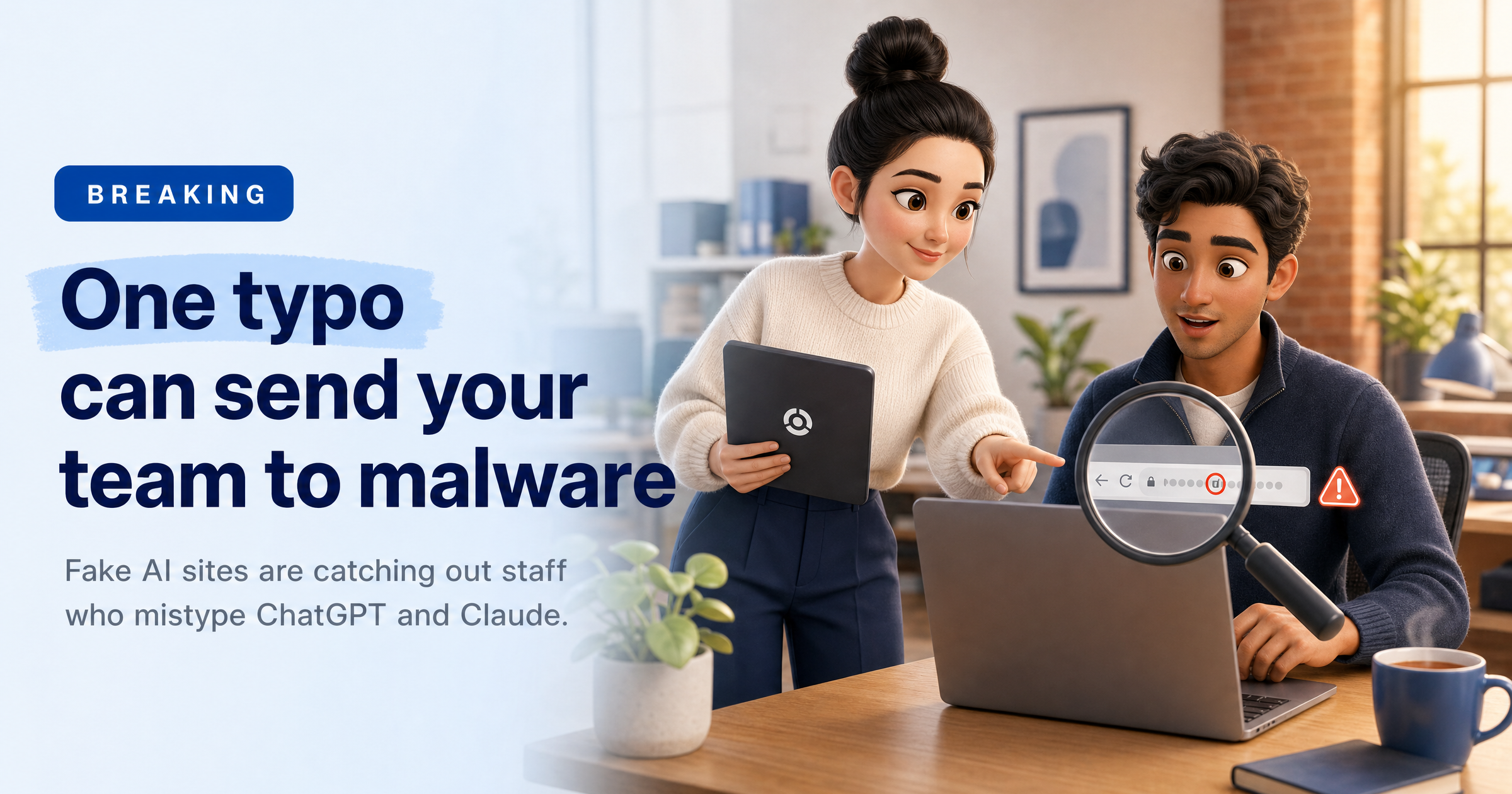
Your team probably types the name of an AI tool into the address bar several times a day. Browser-security researchers at Island have now mapped 186 lookalike web addresses that imitate 27 AI brands, and some of them lead straight to malware.
They call the technique TypoPrompting, and it relies on nothing more than a slip of the finger.
The numbers
In research published on 12 November 2026, Island traced 186 lookalike domains across 27 AI brands. ChatGPT is the most imitated with 25, followed by Claude with 18 and DeepSeek with 16. Some of the domains are simply parked or used for advertising redirects. Others were tied to malicious activity.
One caution: Island counted domains and traced where they lead. It did not publish how many people were infected, so nobody can say yet how many businesses have been caught out.
How a typo becomes an infection
Island followed the mistyped addresses to three different outcomes.
A fake security check. A mistyped Claude address led to a page imitating a Cloudflare verification. It told the visitor to paste and run a command on their Windows PC, which quietly ran a hidden PowerShell script. This trick is known as ClickFix.
A genuine-looking app. Eight lookalike domains led to fake security checks that delivered an app called Net Guard. It carried a real Microsoft Store signature, yet it could change the browser's search settings and run scripts supplied remotely by its operators.
A search-hijacking extension. A mistyped Perplexity address led to a Chrome extension that sets the browser's default search to a site chosen by the attacker. It is one of a network of 30 related extensions. On 3 November, 17 were still listed in the Chrome Web Store, showing 972,000 declared users between them. Those are the figures on the listings, not verified numbers.
What this means for UK small businesses
Most small firms have no one watching for lookalike websites. Staff are also using AI tools more and more, often typing the address from memory rather than using a bookmark. That makes a mistyped name an easy way in.
The attacks need your team to do something, such as paste a command or install an app, so the good news is that a few clear habits stop most of them.
What to do this week
Bookmark the real AI tools. Give staff bookmarks or shortcuts to the AI services you approve, and ask them to use those instead of typing the address.
Never paste and run a command from a website. A genuine "are you human?" check never asks you to open the Run box or a terminal. If a page does, close it.
Check search settings and extensions. On each work browser, look at the default search engine and the extension list. Remove anything nobody chose on purpose.
Install apps only from approved sources. A Microsoft Store signature on its own did not make Net Guard safe, so a pop-up telling someone to install an app is a reason to stop and ask.
Know what to do if it has happened. If someone has already run a command from a strange page, disconnect that device from the network, tell your IT provider straight away and change passwords from a different, clean device.
Sophia Says
"This one is clever because nobody does anything silly. Someone types a name they use every day, gets one letter wrong, and lands on a page that looks calm and professional. The weak point is a habit, so the fix is a habit too: bookmark the real thing and never run a command a web page hands you."
"At HackRisk we help you build those habits with phishing simulations and awareness training, and our Dark Web Scan can show whether your business's email addresses have already turned up in leaked data. Small teams can do this properly without a security department."
— Sophia, HackRisk AI Security Analyst
Where HackRisk fits
Fake pages that ask your team to act: phishing simulations let your staff practise spotting this kind of lure in a safe setting.
Habits like bookmarking and never running pasted commands: security awareness training helps your team make them stick.
Worried a login has already leaked: the HackRisk Dark Web Scan checks whether your business's email addresses have appeared in leaked data.
Get your free HackRisk report
See where your business stands in plain English. Get your free HackRisk report.