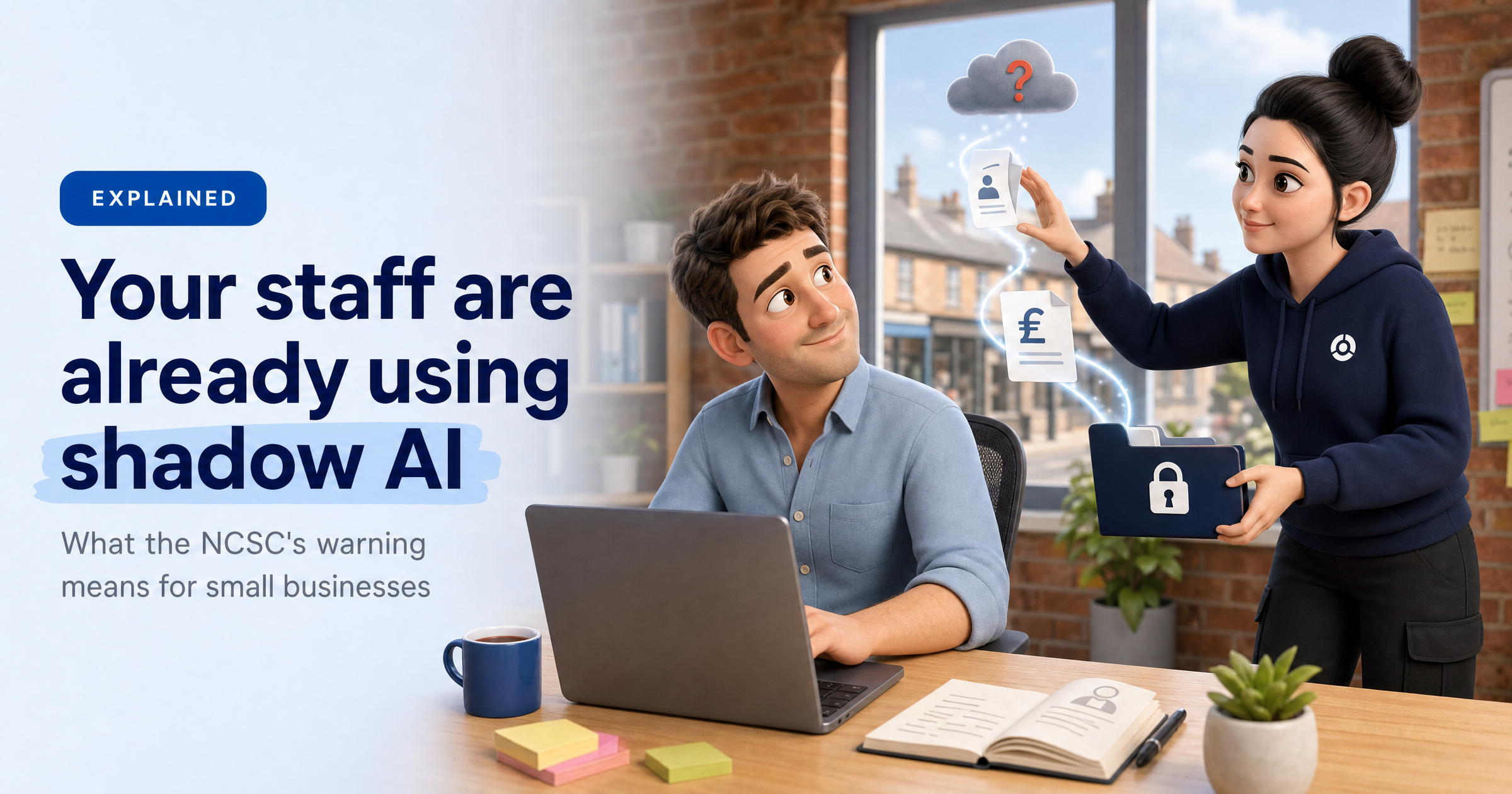
Somebody in your business has probably pasted a customer email, a quote or a spreadsheet into a free AI chatbot this week to save themselves half an hour. They weren't being reckless. They were trying to get their job done. The UK's National Cyber Security Centre (NCSC) has a name for it, "shadow AI", and it has just published a warning about the risks it brings.
What happened
On 7 September 2026 the NCSC published The hidden risks of shadow AI. It defines shadow AI as "the use of AI technology which isn't captured in an organisation's approved systems and processes". In other words, AI tools your staff use that nobody has checked or signed off.
The NCSC points to Microsoft research from October 2025, carried out by Censuswide with 2,003 UK employees, which found that 71% had used unapproved consumer AI tools at work and 51% were still doing so every week. People used them to draft workplace communications (49%), create reports and presentations (40%) and handle finance-related tasks (22%). Only 32% said they were worried about the privacy of company or customer data they put into them.
Small firms are not ahead of the curve. In a 21 September article, ESET reported that 40% of the 4,400 small and medium business decision-makers in its 2026 global survey didn't have an AI policy at all. That survey is global rather than UK-only.
Why shadow AI is a security problem
Your data leaves the building
The NCSC's first worry is data exposure. When someone pastes company or customer information into a consumer AI service, the NCSC says it "may be stored, retained or used to improve the service – outside established security and governance arrangements". You don't know where it lives, who can see it or how long it's kept. If that information includes personal data about your customers, you may struggle to show you've met your UK GDPR obligations.
You lose sight of what's happening
You can't protect what you don't know about. As the NCSC puts it: "You cannot manage what you do not know." Unapproved tools sit outside your normal checks, so there's no review of the supplier, no control over who has access and no record of what was shared.
AI agents open new doors
The newer generation of AI "agents" can read your inbox, open shared drives and send messages on your behalf. The NCSC warns that "AI agents are complex pieces of software that can have critical security vulnerabilities". ESET adds a practical warning: between March and May 2026 it scanned nearly 900,000 add-on "skills" for AI agents and found more than 25,000 suspicious and more than 3,000 outright malicious, leading to credential theft, data theft and remote code execution.
What this means for UK small businesses
Banning AI isn't the answer, and the NCSC says so. It warns that blocking AI can push staff towards tools that haven't been approved, which makes the problem harder to see. The productivity gains are real, and your team will keep looking for them.
The better route is to make the safe way the easy way: pick tools you trust, set simple rules and talk openly about it. That matters more as attackers use AI too. Microsoft's Digital Defense Report 2025, quoted by ESET, found AI-automated phishing emails achieved a 54% click-through rate, against 12% for standard attempts.
What to do this week
Ask, don't accuse. Send a short, friendly message asking which AI tools people use and what for. You'll get honest answers if nobody feels they're in trouble.
Pick an approved tool. Choose one or two AI services with business terms that cover how your data is stored and used, and tell everyone that's the one to use.
Write a one-page AI policy. Cover what can go in (public information, drafts) and what never can (customer personal data, passwords, financial details, anything confidential).
Check AI agents before you connect them. Before an AI tool gets access to your email, calendar or shared drives, ask what it can read and send, and give it the minimum access it needs.
Train for the new phishing. AI-written scam emails are more convincing, so refresh your team's awareness and test it.
Sophia Says
I love that people are finding clever ways to work faster with AI. Shadow AI isn't a story about bad staff, it's a story about busy staff with no clear guidance. The risk is real, but so is the fix. Most small businesses can get on top of this in a week with an honest conversation, one approved tool and a short policy everyone understands.
HackRisk can't see what someone types into a chatbot, and I won't pretend otherwise. What I can do is watch everything around it. I check the dark web for your team's leaked logins, map the systems and services you have facing the internet, flag risky suppliers and help your people spot the AI-written phishing emails heading their way. Your report explains it all in plain English, with clear steps to fix each issue.
— Sophia, HackRisk AI Security Analyst
Where HackRisk fits
Staff using AI unsafely: Security Awareness Training builds the habits and confidence for a positive security culture, which is what the NCSC recommends.
AI-written phishing: Phishing Simulations test how your team handles realistic scam emails, safely.
Leaked work logins: a Dark Web Scan finds staff email addresses and passwords exposed in breaches, including breaches at online services they've signed up to.
Things you didn't know were online: a Recon Scan maps your internet-facing footprint so new, unofficial services don't go unnoticed.
The AI suppliers you do approve: Supply Chain Risk monitoring keeps an eye on the security of the companies you rely on.
Weak spots attackers look for: a Vulnerability Scan checks your public systems for known flaws.
See what's visible from the outside
Shadow AI starts inside your business, but attackers start outside it. Get your free HackRisk report to see your external risks in plain English, with no installation and no card details.
Sources
NCSC: The hidden risks of shadow AI (7 September 2026)
Microsoft UK: Rise in shadow AI tools raising security concerns for UK (13 October 2025)
ESET WeLiveSecurity: The SMB cybersecurity squeeze (21 September 2026)
ITPro: The NCSC is calling for a crackdown on shadow AI (8 September 2026)