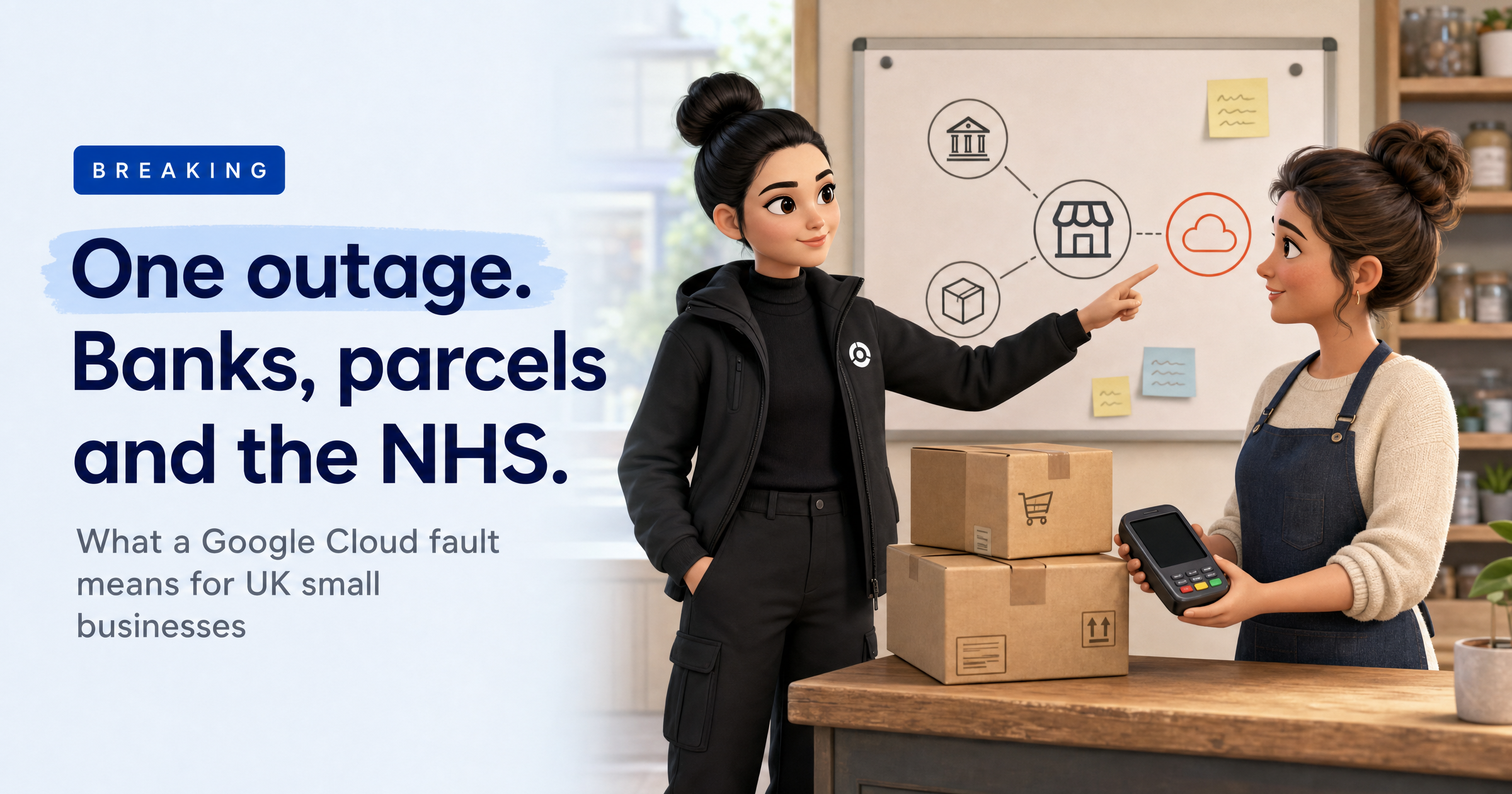
Customers of Revolut and Lloyds woke up on Tuesday unable to make payments or see their money. Parcel tracking stalled, and NHS England was among the organisations reported as affected. None of this was down to a hacker that we know of. These services all lean on the same cloud region, and it had a bad morning.
What happened
Google Cloud began reporting problems with services in its europe-west2 region, which is its London location. Tom's Guide's live coverage says Google's status page logged the issue at 10:35am UK time, describing network errors and intermittent failures, and that banks such as Revolut and Halifax, delivery firms such as DPD and the NHS were all affected.
According to LBC, users of Revolut and Lloyds reported being unable to make payments or reach their funds through the apps. Downdetector also showed problems at HSBC, Screwfix, Rightmove and DPD. LBC reported Google saying the problem was first spotted shortly after 7am, so the sources disagree on when it started.
By late morning, TechRadar's live blog noted that complaints about several of the affected services, including Revolut, Lloyds, Rightmove and DPD, were starting to ease. At the time of writing, Google hasn't published a cause.
Why one region can hit so many names
It's easy to think of the cloud as something vague and permanent. In practice it's a set of physical regions, and plenty of well-known services run their apps, payments and tracking systems in the same one. When that region has a problem, businesses with nothing else in common can fail at the same moment.
That's what made today unusual. It wasn't one app failing. It was the infrastructure underneath several of them.
Outage or attack?
Nothing we've seen so far points to a cyberattack, and Google hasn't given a cause, so we're not going to guess. But that doesn't make it a non-security story.
Availability is one of the three pillars of security, alongside confidentiality and integrity. If your customers can't reach you, or you can't reach your own systems, it's a business problem whatever the reason.
What this means for UK small businesses
You probably don't run anything in Google's London region yourself. But your suppliers might. Your bank, your payment provider, your couriers, your booking system and your accounting software all sit on somebody's cloud, and you may never have asked whose.
On a day like this, small firms feel it in practical ways: card payments or online orders fail, deliveries and collections slip with no tracking updates, staff can't get to the tools they need, and customers start phoning to ask what's going on.
What to do this week
List your critical suppliers. Write down the five or six services that would stop you trading if they failed: payments, email, accounting, booking, delivery, your website host. Add who to contact and where each one's status page lives.
Ask about resilience. Ask your key suppliers where they host and what happens if that region fails. A good supplier will have an answer, and a vague one tells you something too.
Have a "systems are down" plan. Decide how you'd take a payment, contact customers and keep staff informed if your main tools vanished for a few hours. Keep the plan on paper or somewhere that doesn't depend on those same tools.
Keep a second route to your money. If you rely on one bank app or one payment provider, make sure there's a back-up, even if it's only a second account and a card reader from a different provider.
Tell customers early. A short, honest message on your website, social channels or phone line costs nothing and saves a lot of frustration.
Sophia Says
As far as anyone can tell, today wasn't a hacker's doing, but I'd still treat it as a security lesson. If you can't see what your business depends on, you can't plan for it going wrong, and that's true whether the cause is a faulty update or a criminal.
That's why I look at the things you rely on, not just your own systems. HackRisk helps you map what's connected to your business and spot weak points in your suppliers and your own digital footprint, so a bad day somewhere else doesn't catch you completely off guard.
— Sophia, HackRisk AI Security Analyst
Where HackRisk fits
- Know what you depend on: Supply Chain Risk helps you see how exposed you are through the suppliers you rely on.
- See what you expose: Recon Scan shows what your business looks like from the outside, including the services and domains tied to you.
Get your free HackRisk report
Find out where your business is exposed, including through the suppliers you depend on. Get your free HackRisk report.